Educational overview only. Prudent Guardian (www.inspirecodingedu.com) is not an insurance company, broker, law firm, or registered investment adviser, and does not provide personalized insurance, investment, tax, medical, or legal advice. Verify details with licensed professionals and official issuers.
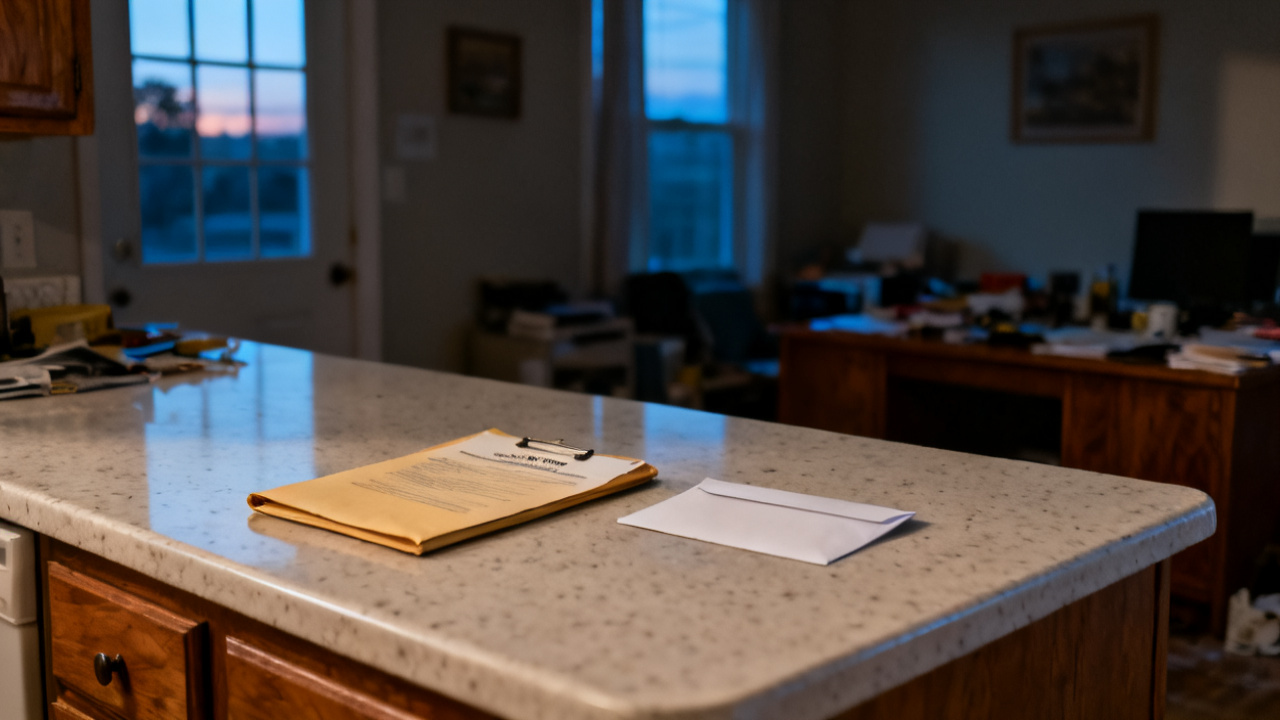
The amount is blank. Someone asked you to write it in. You hover your pen over the line, thumb brushing the smudge of dried concrete along the paper’s lower edge, and run through the last 28 days of work on the site in your head. No one else is in the small field office with you right now, the only sound the hum of the space heater under the desk and the distant beep of a backing excavator through the cracked side window. You know filling that number wrong can ripple out to every crew lead, material supplier, and equipment rental shop you work with, so you don’t rush, setting your phone on do not disturb to eliminate distractions while you work through the math.
What this partial pay request lists
Every other field on the single-page document is pre-filled, save for that single total line at the bottom right. The top of the page has your company’s legal name, tax ID number, the project’s full street address, and the pay period end date typed in clear, 12-point font. Below that, a line-item breakdown of every scope of work you completed over the 28-day cycle: 4,200 square feet of slab prep on the west ground-floor wing, 1,875 linear feet of metal stud framing for the second-floor mechanical chase, 2,100 square feet of plywood sheathing for the east exterior wall, and three separate change order line items for unplanned utility trenching near the site entry. Each line has a pre-loaded unit cost that matches the values laid out in your signed contract, and a completed quantity field that the GC’s project manager signed off on last week during your scheduled joint walkthrough, before their admin team notified you their pay tracking spreadsheet corrupted overnight, leaving that total line blank for you to fill before the 5PM submission cutoff. To calculate the correct value to enter, you follow a consistent sequence of steps you use for every pay request across all your active projects:

- Multiply each line item’s completed quantity by its assigned unit cost, writing the subtotal for each line in the wide left margin next to the item to avoid mixing up numbers as you move down the page.
- Add all line item subtotals together to get a gross work completed value for the pay period, double-checking your addition by adding the numbers in reverse order 10 minutes after your first calculation to catch simple arithmetic errors that often happen when you’re rushing to hit a deadline.
- Subtract the total amount you already received in previous pay cycles for this project, pulling that number directly from the deposited check stubs you keep tucked in the front of your dedicated project folder instead of relying on the GC’s partial payment records, which have had minor clerical errors in past cycles.
- Deduct the 10% retainage specified in your signed contract, adjusting only for any retainage release you received written confirmation for earlier this month, which applies only to work completed in the first two pay periods of the project.
- Add any approved change order amounts for work completed outside the original scope this pay period, confirming each has a signed, dated copy to attach to the back of the request before you submit it.
Illustrative example: If your line item subtotals add up to $147,200, you’ve received $89,500 in prior payments, and retainage due for this cycle is $5,770, the final amount you write on the blank line is $51,930. You double-check that number twice, write it out in both numerals and printed words on the corresponding line below the blank total field, and sign your name next to it before moving to cross-reference the figure against your own records.
How this figure aligns with your internal cost tracking for the pay period
You pull your leather-bound field cost log out of your work bag, flipping to the color-coded tab for this project, and cross-reference the number you just calculated against the total of all labor, material, and equipment costs you incurred for work on this site over the last 28 days. You don’t just check if the number makes sense at a glance – you verify that the gap between the requested pay amount and your out-of-pocket costs is consistent with the 18% margin you agreed to when you signed the contract, with no unexpected shortfalls that would leave you covering crew wages out of your operating account for two weeks while you wait for payment to process. You cross-check the line item quantities again against the timestamped photos you took during the joint walkthrough, making sure every square foot of slab you poured, every linear foot of framing you installed, every foot of trench you dug, is accounted for in the pre-filled quantity fields, because you don’t want to leave money you’re owed on the table, and you also don’t want to request a penny more than you earned, to keep your working relationship with the GC on solid ground. You cross-reference the change order amounts with the digital copies stored in your Draw Jacket folder to confirm no approved adjustments are missing from the pre-filled list, and note that all three change orders are included, with quantities matching your field logs. You do a final check to make sure you haven’t missed any eligible costs, like the extra overtime you paid your crew to finish the trenching ahead of the scheduled utility inspection, which is included in the third change order’s unit cost. Once you’re confident the number is accurate, you staple all supporting documents to the back of the pay request and slide it into a plain manila envelope.
When you pull this pay request back out for reference
You stand up from the desk, slip the envelope into your jacket pocket, and drop it in the GC’s front office locked drop box on your way back to the site to check on the crew’s progress with the exterior sheathing. You don’t hear anything about the request for 12 days, when you get an automated email notification from your bank that a deposit from the GC’s construction account has hit your operating account, and that’s when you pull the original copy of the pay request back out of your project file to cross-reference the deposited amount against the number you wrote on that blank line. You note any discrepancies between the requested amount and the deposited amount, writing them in the empty margin next to the total you wrote, so you can follow up with the GC’s accounting team to clarify what was deducted and why, before the next pay cycle submission deadline rolls around. If the amounts match exactly, you jot the deposit date and check number in the margin as well, and staple a copy of the corresponding bank deposit slip to the back of the request for your records. You file the page back in your project folder’s “processed payments” tab with any email correspondence about the payment, so you have a clear, unbroken paper trail for every dollar tied to the project, from the first mobilization payment before you broke ground to the final retention release you’ll request after the project passes its final occupancy inspection. You don’t discard the page even after the project closes out, keeping it stored in your archival files for seven years, alongside all other project documentation, so you can reference it if any questions about payment for that pay period come up down the line. Even if no questions arise, you pull the page out once a year during your annual tax preparation process, to cross-reference reported revenue against the work completed that cycle, making sure your filings align with the physical records you kept on file.